How to Choose Indoor or Outdoor AC Chargers?

Time:2026-10-27 Author:Liam
0%

Choosing an AC charger is not simply an indoor-versus-outdoor vote. The right choice depends on climate, parking habits, electrical capacity, and long-term maintenance. The International Energy Agency reported nearly 14 million electric car sales worldwide in 2023. It also recorded more than four million public charging points, with installations growing by over 40%. These figures show a practical reality: charging equipment is moving into garages, apartment areas, workplaces, and exposed parking spaces.

Understanding how indoor and outdoor AC chargers differ helps buyers avoid expensive assumptions. Indoor chargers usually face fewer problems from rain, dust, ultraviolet light, and freezing temperatures. A garage installation may therefore require less environmental protection. Outdoor chargers need careful attention to enclosure strength, cable storage, drainage, condensation, and impact resistance. IEC 60529 classifications, such as IP ratings, offer a useful way to compare protection against water and solid particles. However, an IP rating does not solve every installation problem.

Power matters too. The U.S. Department of Energy’s Alternative Fuels Data Center describes Level 2 charging as commonly using 208–240 volts, with output varying by equipment and circuit capacity. Real charging speed still depends on the vehicle, wiring, temperature, and available grid power. More power is not always better. In a cold driveway, a technically powerful charger may perform less impressively than expected. This article will compare installation conditions, safety features, durability, convenience, and ownership costs. The recommendations are practical, but not perfect. Local electrical inspection requirements and manufacturer instructions must remain part of the decision.
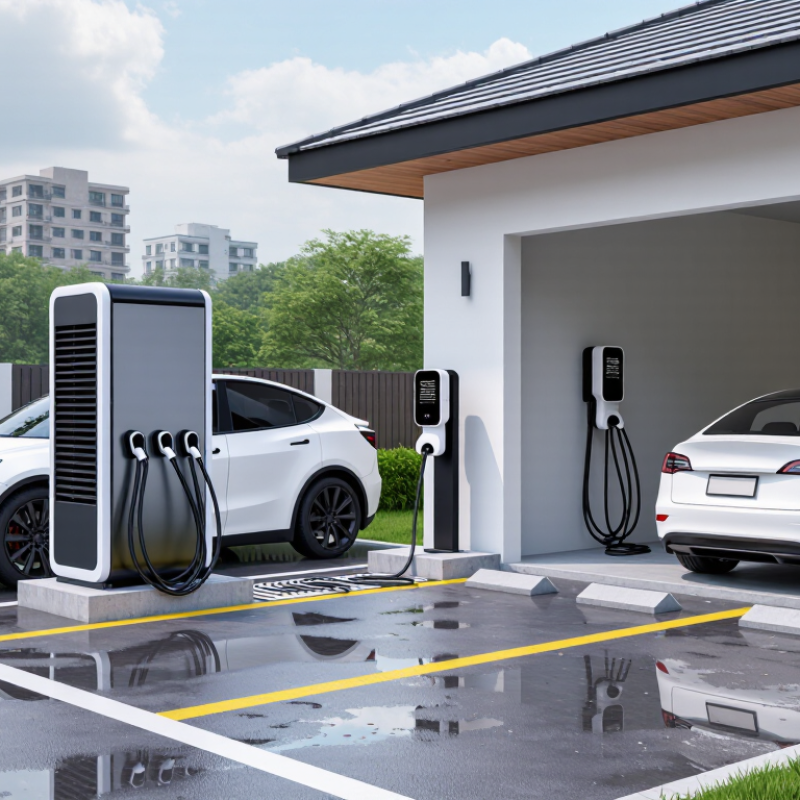
How to Choose Indoor or Outdoor AC Chargers?

Define AC Charger Types: SAE J1772 Level 1 at 1.9 kW and Level 2 up to 19.2 kW

How to Choose Indoor or Outdoor AC Chargers?

For most homes, SAE J1772 AC charging falls into two practical levels. Level 1 typically delivers up to 1.9 kW from a standard household circuit. It may add roughly 3–5 miles of range per charging hour, depending on the vehicle. Level 2 can reach 19.2 kW, although many residential installations operate between 7.2 and 11.5 kW. The U.S. Department of Energy’s Alternative Fuels Data Center lists these ranges and stresses that vehicle limits, circuit capacity, and installation conditions affect real charging speed.

Level 1 suits drivers who travel short distances and park overnight. A cable beside an indoor outlet is simple, but older wiring deserves inspection.

Level 2 is more practical after longer commutes. It can refill a typical battery during several evening hours. Still, higher power is not always better. That assumption needs questioning. The vehicle may accept less power, or the home service may require an expensive upgrade.

Indoor installation offers cleaner surroundings and easier equipment checks. Outdoor installation needs a weather-resistant enclosure, protected cable routing, and connectors rated for moisture and temperature changes. Keep the plug away from puddles and avoid tightly coiling a warm cable. The IEA’s Global EV Outlook 2024 reports more than four million public charging points worldwide at the end of 2023, showing rapid infrastructure growth. Yet home charging remains highly personal. Measure daily mileage, parking time, and electrical capacity before choosing.

Match Installation Location to IEC 61851 Mode 3 and IP54–IP65 Protection

Choosing between an indoor and outdoor AC charger starts with the installation environment, not appearance. IEC 61851 Mode 3 equipment communicates with the electric vehicle through a control pilot connection. This supports controlled charging and safety checks during operation. A garage usually offers better protection from rain, sunlight, and freezing temperatures. However, dust, condensation, and limited ventilation still require attention.

Outdoor installations need stronger enclosure protection. IP54 resists limited dust entry and water splashes, while IP65 provides dust-tight protection and resistance to low-pressure water jets. These ratings matter near driveways, where rain can strike from several directions. IP65 is not a complete weather solution. Direct sunlight, ice, salt, poor drainage, and cable connectors can still cause trouble. Use suitable mounting height, UV-resistant cabling, and a location away from standing water.

In practice, installation details often decide reliability. A charger under a roof may need only moderate protection, while an exposed wall deserves a higher rating. Check the manufacturer’s temperature range, ventilation requirements, and cable entry design. Confirm that residual-current protection, earthing, and circuit sizing meet local electrical rules. Small oversights matter. A sealed enclosure cannot compensate for an incorrectly fitted gland or an open connector. I would also inspect the site after heavy rain, because the first plan is rarely perfect.

How to Choose Indoor or Outdoor AC Chargers?

Match the installation location to IEC 61851 Mode 3 and IP54–IP65 protection

The chart compares the two IP code digits. IP54 provides level 5 protection against dust and level 4 protection against splashing water, while IP65 provides level 6 dust-tight protection and level 5 protection against water jets. IEC 61851 Mode 3 defines the controlled AC charging communication and safety process; it does not prescribe a specific IP rating. Select the final enclosure rating according to the actual indoor or outdoor exposure, installation instructions, and local electrical requirements.

Evaluate Indoor and Outdoor Safety Using NEC Article 625 Requirements

How to Choose Indoor or Outdoor AC Chargers?

The location should follow NEC Article 625, not convenience alone. NEC 625.5 requires listed equipment, while 625.22 addresses personnel protection against electric shock. A licensed electrician should confirm the charger, circuit, grounding, and overcurrent protection. Local authorities may enforce newer NEC editions differently.

Indoor charging usually offers better protection from rain, snow, and physical impact. Yet a garage is not automatically safe. Keep the charger away from fuel vapors, standing water, stored chemicals, and blocked ventilation paths. The International Energy Agency reported more than 14 million electric cars were sold globally in 2023. That growth increases demand for dependable home charging, but rushed installations still create avoidable risks.

Outdoor charging needs equipment specifically suitable for wet locations. Its enclosure, cable, conduit, connections, and receptacle must tolerate moisture and temperature changes. NEC Article 625 works with other NEC rules covering wiring methods, grounding, and protection from damage.

Inspectors often find a weather-resistant charger connected to an unsuitable receptacle. That combination is not enough.

Data from the U.S. Department of Energy’s Alternative Fuels Data Center shows charging infrastructure continues expanding nationwide, but availability does not prove installation quality. Check the listing, installation instructions, GFCI requirements, mounting height, and drainage around the parking space. A dry inspection today may miss winter ice tomorrow. That deserves a second look.

Compare Weather, Temperature, and Corrosion Resistance with NEMA 3R–4X Ratings

How to Choose Indoor or Outdoor AC Chargers?

Choosing an indoor or outdoor AC charger starts with the installation environment, not the charger’s appearance. Indoor garages usually provide stable temperatures and limited moisture. An outdoor driveway faces rain, snow, dust, sunlight, and condensation. NEMA 3R enclosures protect against falling rain, sleet, snow, and external ice formation. They suit many sheltered outdoor locations. However, they may not resist strong water spray or corrosive air.

NEMA 4 offers stronger protection against dust and hose-directed water. It is useful near exposed parking areas or washdown zones. NEMA 4X adds corrosion resistance, which matters near coastlines, swimming pools, and roads treated with deicing salts. Still, NEMA ratings do not define the charger’s full temperature range. Check operating limits, heat derating, ventilation needs, and cable flexibility. A well-sealed enclosure can still experience internal condensation. I have seen moisture problems caused by temperature changes, not heavy rain. That detail is easy to overlook.

Tips: Match the rating to the real site conditions. Measure nearby heat sources and observe afternoon sunlight. For outdoor mounting, use a certified weatherproof connection and avoid low areas where water collects. Inspect seals, covers, and cable entries regularly. If corrosion is visible, investigate early. A higher rating is not always better if installation practices are poor. Verify local electrical requirements with a qualified professional before installation.

Select Power, Cable Length, and Load Capacity for Your Site’s Daily Demand

How to Choose Indoor or Outdoor AC Chargers?

Daily demand should determine power before appearance. The International Energy Agency reported over four million public charging points worldwide at the end of 2023. That growth makes poor load planning more expensive. For a workplace with eight cars arriving together, an 11 kW charger may need 88 kW before lighting and heating are counted. A 7 kW unit may suit overnight parking, while 22 kW fits shorter stays only when the electrical service can support it.

Check the site’s supply, not just the charger rating. The U.S. Department of Energy’s Alternative Fuels Data Center identifies Level 2 charging as typically using 208–240 volts, with output commonly reaching 19.2 kW. Local demand, phase balance, and circuit protection still control the practical limit. Include a load-management system when several vehicles share one connection. Leave headroom. A calculation based on perfect charging behavior can mislead.

Cable length affects safety and daily convenience. Measure the parking bay, cable route, and connector height, then add only a modest allowance. Excess cable can create loops, trip hazards, and weather exposure. Indoor installations usually need less environmental protection, but outdoor units require suitable ingress protection, drainage, sunlight resistance, and impact positioning. In field assessments, installers often discover that a technically correct charger is awkwardly placed. That mistake is avoidable, though not always obvious on drawings. Recheck the layout with a real vehicle and a real parking maneuver.

How to Choose Indoor or Outdoor AC Chargers? - Select Power, Cable Length, and Load Capacity for Your Site’s Daily Demand

Use the table below to match AC charger power, cable length, environmental protection, and electrical capacity with typical site requirements. Actual installation must be verified against local electrical codes, supply voltage, cable distance, and the building’s available capacity.

Site Scenario Recommended Location Typical AC Power Supply Configuration Approximate Charging Current Recommended Cable Length Minimum Enclosure Protection Suggested Dedicated Circuit Capacity Daily Demand Suitability Selection Notes
Residential parking with overnight charging Indoor garage or covered driveway 3.6–7.4 kW Single-phase, approximately 230 V 16–32 A 5 m; choose 7.5 m when the parking position varies Indoor: IP20 or higher; outdoor: IP54 or higher 20–40 A dedicated circuit, subject to local code 7.4 kW can add approximately 55–60 kWh during an eight-hour session under suitable conditions. Confirm that the home service can support the continuous load.
Apartment or shared residential parking Indoor car park or sheltered outdoor bay 3.6–7.4 kW Single-phase, approximately 230 V 16–32 A 5–7.5 m IP54 or higher for areas exposed to moisture 20–40 A per charging point, with load management for multiple points Dynamic load management can prevent several chargers from exceeding the building’s available electrical capacity.
Office or workplace parking Indoor garage or outdoor employee parking 7.4–11 kW Single-phase at 230 V or three-phase at approximately 400 V 32 A single-phase or 16 A three-phase 5–7.5 m IP54 or higher outdoors 40 A single-phase or 20 A three-phase per point Moderate power is usually sufficient because vehicles remain parked for long periods. Shared load balancing is recommended for larger installations.
Retail, hotel, or restaurant parking Outdoor parking area or semi-covered parking 7.4–11 kW Single-phase at 230 V or three-phase at approximately 400 V 32 A single-phase or 16 A three-phase 7.5 m; use 10 m only where site layout requires it IP55 or higher; use impact-resistant protection in public areas 40 A single-phase or 20 A three-phase per point Longer cables improve parking flexibility but increase handling and cable-management requirements. Protect the cable from vehicle traffic.
Fleet depot with scheduled overnight charging Indoor fleet garage or secure outdoor yard 11 kW Three-phase, approximately 400 V 16 A three-phase 7.5 m Indoor: IP20 or higher; outdoor: IP55 or higher 20 A three-phase per point, with centralized load management Three-phase 11 kW charging provides a practical balance between charging speed and site capacity for overnight fleet operations.
High-turnover public parking Outdoor parking lot or open-air charging area 11–22 kW Three-phase, approximately 400 V 16–32 A three-phase 7.5–10 m, preferably with cable management IP55 or higher; use increased impact protection where required 20–40 A three-phase per point 22 kW requires a suitable three-phase supply and a vehicle capable of accepting that rate. Many vehicles may charge below the station’s maximum power.
Outdoor site with limited electrical capacity Outdoor parking or remote parking area 3.6–7.4 kW Single-phase, approximately 230 V 16–32 A 5 m to reduce cable handling and voltage-drop concerns 20–40 A dedicated circuit with adjustable current limit Set a lower current limit or use dynamic load management when the service has little spare capacity. A site assessment is essential before installation.
Exposed coastal, dusty, or harsh-weather location Fully outdoor, uncovered parking 7.4–22 kW, depending on available supply Single-phase or three-phase 16–32 A, depending on power level 5–7.5 m with secure storage when not in use Match the selected power level and apply local continuous-load requirements Suitable for regular daily use when protected and maintained Choose weather-resistant equipment, sealed cable connections, drainage, physical protection, and periodic inspection for corrosion or mechanical damage.

Notes: Approximate power values are based on common nominal supplies: 230 V single-phase and 400 V three-phase. Charging power may be limited by the vehicle’s onboard charger, the charger configuration, temperature, cable size, or the available site capacity. Electrical circuits should be sized and installed by a qualified professional according to applicable local regulations, including requirements for continuous loads, residual-current protection, earthing, and voltage drop.

FAQS

What should determine an AC charger’s installation location?

The environment matters more than appearance. Consider rain, sunlight, freezing temperatures, dust, drainage, and ventilation.

What does IEC 61851 Mode 3 provide?

Mode 3 uses a control pilot connection between the charger and vehicle. It supports controlled charging and safety checks.

Is an indoor garage always the safest location?

No. A garage can still contain condensation, fuel vapors, chemicals, or blocked ventilation paths. Keep the charger dry and accessible.

What is the difference between IP54 and IP65 protection?

IP54 limits dust entry and resists water splashes. IP65 is dust-tight and resists low-pressure water jets.

Is IP65 enough for a fully exposed outdoor charger?

Not always. Direct sunlight, ice, road salt, poor drainage, and damaged connectors can still create problems.

How can an outdoor charger be protected from weather?

Mount it above likely water levels. Use UV-resistant cabling and suitable conduit. Avoid standing water and direct spray.

What electrical checks are needed before installation?

A licensed electrician should verify grounding, circuit size, overcurrent protection, and residual-current protection.

What does NEC Article 625 require for charger installations?

It addresses listed equipment, shock protection, wiring methods, grounding, and protection from physical damage. Local rules may use newer editions.

Can a weather-resistant charger use any nearby receptacle?

No. The receptacle, cable entry, conduit, and connections must also suit wet locations. One mismatch can undermine the installation.

How should the installation be checked after completion?

Inspect it after heavy rain and during cold weather. Look for water paths, ice, loose glands, and blocked ventilation. The original plan may need revision.

Conclusion

Choosing between indoor and outdoor AC chargers begins with understanding their power levels and installation requirements. SAE J1772 Level 1 charging delivers approximately 1.9 kW, while Level 2 can provide up to 19.2 kW for faster daily charging. How indoor and outdoor AC chargers differ is mainly reflected in environmental protection, installation planning, and safety requirements. Indoor installations may need less weather resistance, but they still require proper ventilation, dedicated circuits, and safe cable management. Outdoor units should support IEC 61851 Mode 3 operation and offer suitable IP54 to IP65 protection against dust and water.

Site safety should be evaluated according to NEC Article 625, including grounding, overcurrent protection, and correct installation procedures. Weather exposure, temperature changes, moisture, and corrosion also make NEMA 3R to 4X ratings important when selecting outdoor equipment. Finally, consider charging speed, cable length, available electrical capacity, and the site’s daily vehicle demand to choose a reliable and practical AC charging solution.

Liam

Liam

Liam is a dedicated marketing professional with a profound expertise in the industry, where he excels at highlighting the unique advantages of our core products. With a keen understanding of market trends and consumer needs, Liam frequently updates our company’s professional blog, providing......