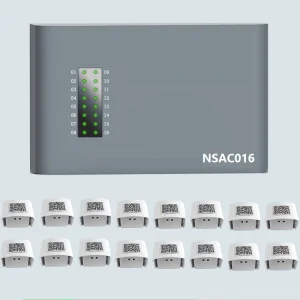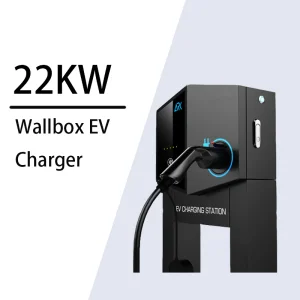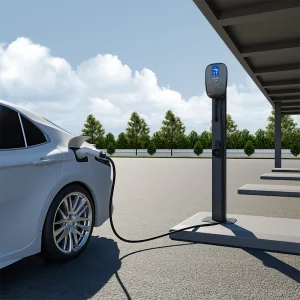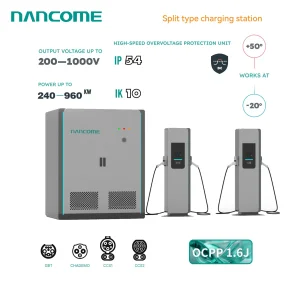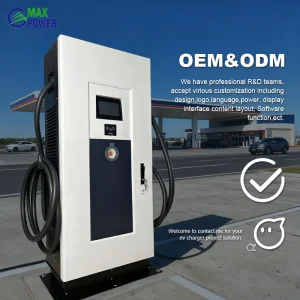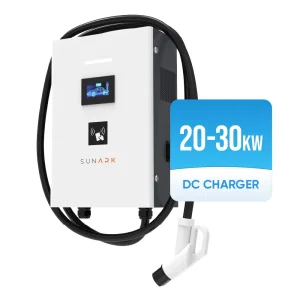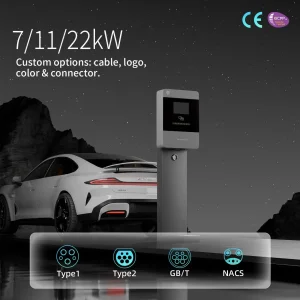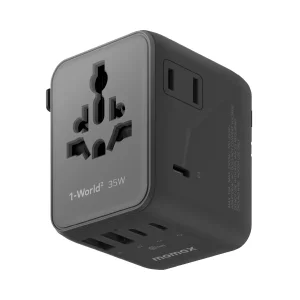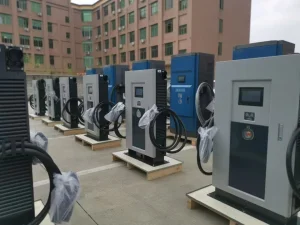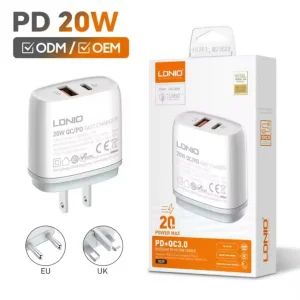
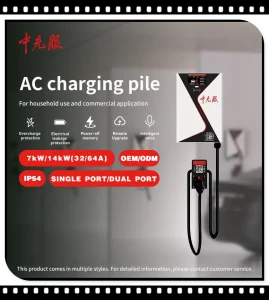
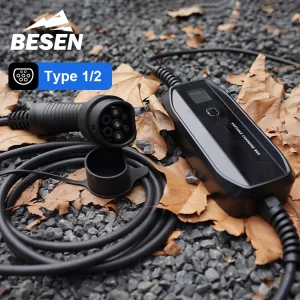
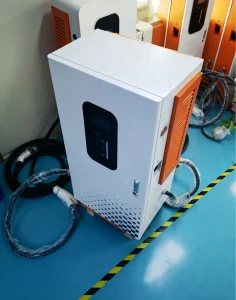
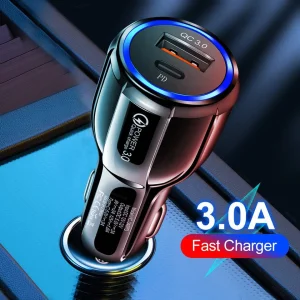
Foshan Walnut Charger Co., Ltd. is a leading manufacturer specializing in advanced AC EV charging solutions for both residential and commercial applications. With a focus on wall-mounted and floor-mounted chargers, the company provides a comprehensive range of smart charging products designed to meet the diverse needs of homeowners, businesses, and fleet operators.
The company’s product portfolio includes high-efficiency AC chargers equipped with intelligent power management systems, dual-port charging options, and real-time monitoring capabilities. By integrating cutting-edge technology, Foshan Walnut Charger ensures optimal charging performance, energy efficiency, and user-friendly operation for every installation.
Committed to sustainable mobility, Foshan Walnut Charger emphasizes seamless integration of smart home and commercial energy systems. Its solutions support load balancing, remote management via mobile applications, and safety compliance with international standards, providing reliable and efficient charging for all electric vehicles.
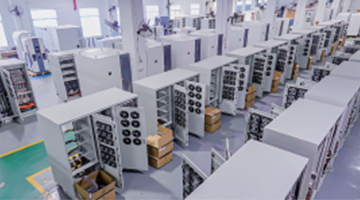
With strong R&D capabilities, rigorous quality control, and a customer-centric approach, Foshan Walnut Charger has established itself as a trusted partner in the EV charging industry. The company’s mission is to deliver innovative, safe, and energy-efficient charging solutions that empower customers to embrace electric mobility while optimizing energy use and reducing costs.
The global transition towards zero-emission transportation is accelerating at an unprecedented pace. Industry analysts estimate that the total number of electric passenger cars, delivery fleets, and public buses on the road will surpass several hundred million by 2030. To sustain this exponential growth, the deployment of intelligent electric vehicle maintenance systems and structural charging networks is paramount.
In mature markets like North America, Western Europe, and parts of the Asia-Pacific region, governments are enacting legislation requiring commercial facilities to implement EV-ready parking stalls. This regulatory shift is no longer just about offering a convenience; it has evolved into a strategic commercial operation. Commercial operations require high availability rates (often targeted at 99.9% uptime), rugged hardware configurations, and multi-tenant smart load-balancing protocols to prevent localized grid overloads.
Modern electric vehicle supply equipment (EVSE) is undergoing a major paradigm shift. Hardware is no longer isolated from the network; instead, it is transforming into an edge computing device that actively monitors vehicle health during the power injection process. Here are the core technical trends defining this transformation:
Modern charging infrastructure dynamically alternates between single-phase and three-phase charging depending on structural building loads, improving utility efficiency and safety.
Seamless communication protocol enabling direct cryptographic authentication between the EV and the charger, eliminating the need for RFID cards or mobile apps.
By monitoring power quality anomalies, current leaks, and temperature spikes at the gun nozzle interface, systems can flag maintenance before component failure.
As these developments take shape globally, the integration of high-temperature resistant PCB materials, real-time remote firmware updates (FOTA), and localized thermal runaway suppression algorithms has become standard practice for top-tier manufacturers like Foshan Walnut Charger.
Industrial procurement leads, logistics fleet managers, and municipal urban planners look at EV charging solutions through a lens of Total Cost of Ownership (TCO) and operational resilience. Global enterprise purchasing mandates typically require compliance with a rigid framework of quality metrics:
Through our comprehensive R&D capabilities at Foshan Walnut Charger Co., Ltd., we directly answer these needs by supplying modular, pre-configured structures built to adapt to diverse international power requirements.

China's manufacturing landscape has evolved beyond raw scale to prioritize precision engineering, automated reliability, and unmatched supply chain consolidation. Our advanced production site in Foshan leverages localized component sourcing networks—ranging from high-durability polymers to micro-relays and semiconductor controllers.
This geographic concentration allows us to run highly efficient production loops, drastically reducing lead times while maintaining strict IATF 16949 automotive quality standards. Every charger that leaves our assembly line undergoes automated testing regimens, simulation burn-ins, and high-voltage resistance trials to ensure full reliability.
For international buyers, this equates to reduced landed costs, steady inventory dispatch, and structural adaptability that ensures minor design adaptations can be resolved inside our facility without causing shipment bottlenecks.
A global maintenance and charging solution must adapt to regional electrical topologies and local geographic demands. Here are the core environments where Foshan Walnut Charger equipment is actively deployed:
Integrating with home solar systems, our smart wallboxes use load-balancing algorithms to charge vehicles during off-peak windows, protecting household electrical networks.
Optimized for high-volume operation, these systems use multi-gun outputs and smart OCPP software, allowing commercial managers to monitor operations and bill users.
Equipped with rugged IP65-rated enclosures and clear displays, these units offer reliable public charging and support localized ad placement to generate added revenue.
Whether facing extreme sub-zero winters in Northern Europe or handling intense high-temperature cycles in the Middle East, our materials and thermal-isolation designs deliver consistent power output and maintain overall vehicle grid safety.
To establish true hardware authority, it is critical to detail the underlying electrical architecture used in modern industrial EV maintenance infrastructure. Standard AC charging installations face complex electrical hazards: overvoltages, transient grid surges, and gradual ground faults. The Foshan Walnut Charger range features a comprehensive three-tier electrical safety framework:
Traditional AC systems rely exclusively on standard Type A RCD breakers. However, modern EV onboard converters can leak small amounts of smooth DC fault currents. If these DC currents exceed 6mA, they can saturate the core of a typical Type A sensor, leaving it unable to detect hazardous AC faults. Our intelligent EVSE integrates specialized DC 6mA residual current detection modules, offering complete electrical protection without requiring expensive upstream Type B RCD installations.
When charging multiple vehicles simultaneously, buildings face high peak energy demand. Our proprietary DLB technology continuously reads main building power usage with local current transformers (CTs). By adjusting current delivery on the fly, the system maximizes charging speed without overloading main breakers, protecting the local facility grid.
Continuous high-amperage charging generates considerable heat at the connector pins. Our charging guns include integrated NTC temperature sensors that actively communicate with the controller. If the contact temperature exceeds 80°C, the system automatically dials down the charging current; if the temperature reaches 85°C, it cuts power entirely to protect components.
 Walnut Charger